 -35% OFF
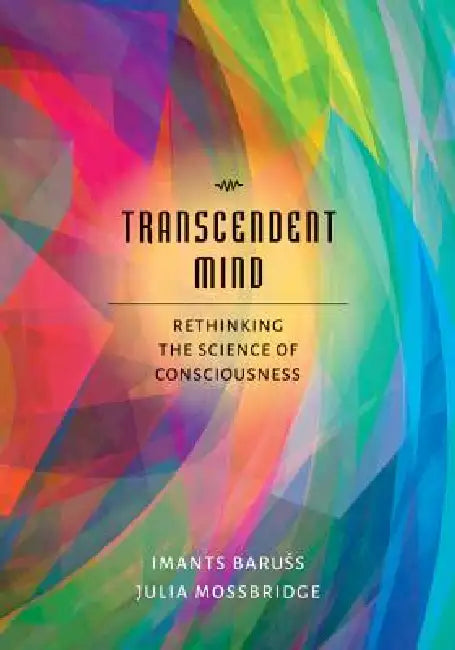
Transcendent Mind (English, PhD Baruss Imants | Julia Mossbridge)
4.7(46 reviews)by PhD Baruss Imants | Julia Mossbridge
Publisher: American Psychological Association (APA)
Language: English
Inclusive of all applicable taxes. Free shipping on orders above ₹499, else ₹49 flat.
Available Offers
- 🚚Free Delivery — Free on orders above ₹499, else ₹49 flat
- 💵Cash on Delivery — Pay when your order arrives
- ↩️15-Day Easy Returns — Hassle-free return policy
- 🔒Cash on Delivery — Pay safely when your order arrives
Check Delivery
Specifications
| Publisher | American Psychological Association (APA) |
| Language | English |
| ISBN-13 | 9781433822773 |
| ISBN-10 | 1433822776 |
| Author | PhD Baruss Imants | Julia Mossbridge |
Product Description
About the Book
Everyone knows that consciousness resides in the brain. Or does it? In this book, Imants Baruss and Julia Mossbridge utilize findings from quantum mechanics, special relativity, philosophy, and paranormal psychology to build a rigorous, scientific investigation into the origins and nature of human consciousness. Along the way, they examine the scientific literature on concepts such as mediumship, out-of-body and near-death experiences, telekinesi…
ISBN: 9781433822773
Book Insights
What You'll Learn
- ·In-depth exploration of topics covered in Transcendent Mind
- ·Key concepts explained with clarity and practical examples
- ·Insights valuable for anyone studying or working in American Psychological Association (APA)
Who Should Read This
Students and professionals interested in American Psychological Association (APA), as well as general readers looking to expand their knowledge.
Key Highlights
- ·Brand new physical book delivered across India
- ·15-day hassle-free return policy
Customer Reviews
“We are in the midst of a sea change.”
Once upon a time, not so long ago, there was a kingdom called Science whose citizens were guided by a uniform belief — that their consciousness is produced by the chemistry, physiology, and anatomy of the physical brain. Forfeited in this belief was the capacity for free will, as well as any higher meaning and purpose to existence. The possibility that consciousness might survive the physical death of the brain and body was considered heretical and blasphemous. Enormous pressure was exerted on the guardians of science to conform to the concept of materialism undergirding this precious belief system. In support of these beliefs, the centurions of science marshaled enormous bodies of data that, they were convinced, confirmed their views. They were so emphatic in their position that data to the contrary were largely dismissed as irrelevant, and those who dared to challenge the materialistic perspective were often denigrated as traitors to the scientific tradition. But just when the materialistic perspective was considered beyond reproach and safe from significant challenge, there came this shocking announcement from two prominent consciousness researchers: “We are in the midst of a sea change. Receding from view is materialism, whereby physical phenomena are assumed to be primary and consciousness is regarded as secondary. Approaching our sights is a complete reversal of perspective. According to this alternative view, consciousness is primary and the physical is secondary. In other words, materialism is receding and giving way to ideas about reality in which consciousness plays a key role.” This is the opening salvo of Transcendent Mind: Rethinking the Science of Consciousness (page 3).I have introduced my comments about Transcendent Mind as a kind of fairy tale, a product of the imagination, because that is how this book may be regarded by those who have not followed the revelations of consciousness research for the past few decades. Across this period, a formidable body of data has accumulated that the materialistic credo is not merely off base in a few minor details, but is fundamentally flawed beyond repair. The trend toward this view is “quietly occurring within a swiftly evolving and increasingly postmaterialist paradigm,” the authors contend. The explanation of how this “sea change” has come about is the theme of Transcendent Mind.In their challenge to materialism, authors Barušs and Mossbridge contend that “the deep structures underlying our waking consciousness are fundamentally spatially and temporally nonlocal in nature (page 81).” The implications for our understanding of our own minds, and the practical ways in which we lead our lives, are enormous.The authors explore empirical data, too long ignored, indicating that “consciousness is capable of existing in an extended or transcendent state in which it is not completely bound to the brain (page 171).” This data supports the concept of “shared mind,” minds linked across space and time to form a collective, unitary human consciousness. This view of nonlocal, shared, transcendent mind is supported by abundant empirical evidence, as the authors show, such as near-death experiences, telepathy, clairvoyance, and precognition. These phenomena might be predicted from an “unconstrained mind that is directly connected to other minds, probably outside the usual confines of space and apparent time (page 177).”Do not suppose that the idea that consciousness is fundamental and irreducible to anything more basic is some hare-brained notion conjured in the fever dreams of wayward new agers, as is often charged. In fact, consciousness as fundamental has an impressive pedigree. It has been endorsed by some of the greatest figures of twentieth-century science such as Max Planck, the founder of quantum physics: “I regard consciousness as fundamental. I regard matter as derivative from consciousness. We cannot get behind consciousness. Everything that we talk about, everything that we regard as existing, postulates consciousness.” Erwin Schrödinger, the Nobel Prize-winning physicist, agreed: “Although I think that life may be the result of an accident, I do not think that of consciousness. Consciousness cannot be accounted for in physical terms. For consciousness is absolutely fundamental. It cannot be accounted for in terms of anything else.” As to the contention of Barušs and Mossbridge of shared, unitary minds, we find Schrödinger in agreement: “The overall number of minds is just one…. In truth there is only one mind.” And as the eminent physicist David Bohm observed, “Deep down the consciousness of mankind is one. This is a virtual certainty … and if we don’t see this it’s because we are blinding ourselves to it.” (Citations for these quotations are available in my book One Mind, mentioned below.)If you are not intrigued by the evidence in Transcendent Mind, well, bear in mind the adage, “There is a principle which is a bar against all information, which is proof against all arguments and which cannot fail to keep a man in everlasting ignorance — that principle is contempt prior to investigation.”But if you are among those who are hesitant to adopt materialism as part of your personal credo, this erudite, reader-friendly book will perhaps fill in some of the blanks on your map of reality. You may discover not only empirical evidence for transcendent, shared mind, but for a transcendent reality as well.~ Larry Dossey, MDAuthor: One Mind: How Our Individual Mind Is Part of a Greater Consciousness and Why It Matters
An author with great courage. He does not sweep anomalies under the ...
An author with great courage. He does not sweep anomalies under the rug!Some great new views and ideas.Very up to date. Buy it, Read it, keep it for reference
Excellent. Represents a long-awaited paradigm shift
I have been a follower and researcher in Near-Death Experience and allied phenomena, such as telepathy, mediumship, precognition and reincarnation, for nearly 4 decades. Consequently, I have read a great number of books and papers on the subject. However, this book is a very important on many levels. Certainly, it presents all the aforementioned topics, which are challenging and complex, in a way that is very readable. For me though, one of the most important features is the publisher: The American Psychological Association. Recognised as a very conservative organisation, the very fact that they published the book themselves, marks a true paradigm shift in attitude. A shift, which has been many years in the waiting, will I think come as a huge relief to many students and followers of the subject.This book will, I hope, put a great number of sceptics well out of their comfort zone. After all, it’s very true that sceptics have to be right all time; believers need only be right once. Mind you, sceptics tend to avoid books this this.
A must be read book
A pleasant and complete analysis of the limitations of the physicalist metaphysics of mind-brain relationship in comparison with a "transcendent mind" theoretical approach
Landmark book on the new science of Consciousness
I read and watched vidoes quite extensively on consciousness, parapsychology, and stuff like that as prep for a research paper on Consciousness. I am very impressed with this new milestone book from APA Press. The book is very well written, and worth a read. Now, if only they would not price it so high!Consciousness is primary; it exists independently and prior to materials. The authors present a fantastic overarching narrative on Consciousness, with scientifically documented instances that can not be explained by ordinary materialistic perspective. From a falsifiability criterion, then traditional science fails miserably.- There is a fantastic story of a long drawn-out chess game being played in the 1980s between a top chess grandmaster Geza Maroczy who had died in 1951, and Viktor Korchnoi, one of the top grandmasters of the 1980s. A chess novice acts as a 'medium' to connect with Maroczy. The game went on to 48 moves over 7 years, and everyone was watching. They could see that the playing style was definitely Maroczy's. How could that game be possible?- There is another story of a question about a very abstract and rarely discussed cosmological constant being asked to Richard Feynmann, the famous physicist, after his death. This was done through a lady who almost routinely acts as a 'medium' for many dead souls, but knows nothing about physics. What looked like a stupid answer from the medium, was actually the correct answer when the authors looked up Feynmann's documents.There are other stories on precognition, Near Death Experiences and more. Overall, this book is a solidly researched and compiled book.