 -9% OFF
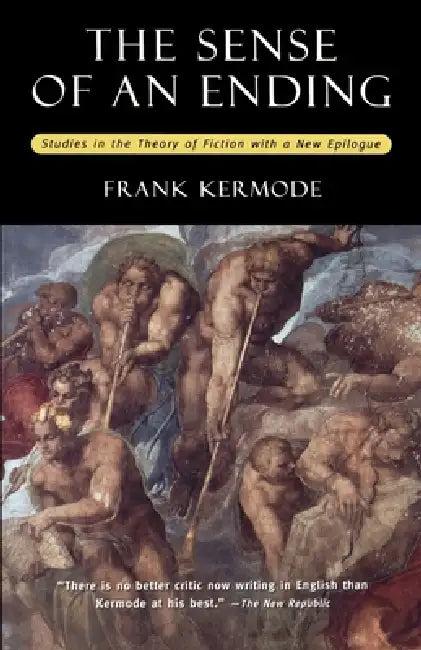
The Sense of an Ending (English, Frank Kermode)
4.3(60 reviews)Inclusive of all applicable taxes. Free shipping on orders above ₹499, else ₹49 flat.
Available Offers
- 🚚Free Delivery — Free on orders above ₹499, else ₹49 flat
- 💵Cash on Delivery — Pay when your order arrives
- ↩️15-Day Easy Returns — Hassle-free return policy
- 🔒Cash on Delivery — Pay safely when your order arrives
Check Delivery
Specifications
| Publisher | Oxford University Press |
| Language | English |
| ISBN-13 | 9780195136128 |
| ISBN-10 | 0195136128 |
| Author | Frank Kermode |
Product Description
Here on GlowMirror, you'll find The Sense of an Ending filed under Oxford University Press -- everything you need to know is covered below.
About the Book
Frank Kermode contributes a new epilogue to his collection of lectures on the relationship of fiction to age-old concepts of apocalyptic chaos and crisis.
ISBN: 9780195136128
Book Insights
What You'll Learn
- ·In-depth exploration of topics covered in The Sense of an Ending
- ·Key concepts explained with clarity and practical examples
- ·Insights valuable for anyone studying or working in Oxford University Press
Who Should Read This
Students and professionals interested in Oxford University Press, as well as general readers looking to expand their knowledge.
Key Highlights
- ·Brand new physical book delivered across India
- ·15-day hassle-free return policy
Customer Reviews
perfect
perfect
Foundational
Apocalyptic literature is one area of novels that is permanent fixed with the ending of a time period, and by nature it has to be. When authors attempt through their literature to prophecy how the future will end up because of social beliefs or actions today or to predict the timing of future events based on oftentimes religious beliefs, they are wrong much of the time. Their reactions, as Kermode describes, are typical. They assume that their belief is still correct but that they were flawed in their analysis of the information, which propels them to reinterpret the facts and try again. It is self-perpetuating.Kermode's topic, that things of this life require a sense that a beginning and an ending exist, feels on first glance absolutely correct all the time. But his claim that we need definitive endpoints to feel a sense of purpose works for novels (the genre he discusses most frequently) does not necessarily show itself true in the short story genre. In short stories, the imitated reality is more like a snapshot of life than a part of life that starts and finishes. Many short stories, like Edgar Allen Poe's "The Cask of Amontillado," Andrea Barrett's "Servants of the Map," and T. Coraghessan Boyle's "The Love of My Life," do follow the tick-tock chronos phenomenon most present in novels, but many short story authors like Raymond Carver in "Kindling" and "Cathedral" leave the reader with a sense that although there may be a beginning and end to the conflict in the story there is not an end to that character's life, even though the book itself has to come to a close. The character's life continues on after the reader leaves the story, and oftentimes the conflict also remains unresolved.That said, Kermode's theoretical approach to endings in literature is foundational to the study of novels and writing in general. It is a work worth reading.Reviewed by Jonathan Stephens
Avoidably polysyllabic
Frank Kermode, “The Sense of an Ending: Studies in the Theory of Fiction with a New Epilogue.” First published 1967, this edition (with the new epilogue) published 2000. The importance of the eschaton in the creation of fiction. From page 5, “fictions, whose ends are consonant with origins, and in concord, however unexpected, with their precedents, satisfy our needs. So we begin with Apocalypse, which ends, transforms, and is concordant.” From page 191(in the new epilogue), “because it was written thirty-odd years too early for me to be much bothered by the millennium, ‘The Sense of an Ending’ was only incidentally concerned with calendrical issues, its central interest being rather eschatological.” Kermode writes from the point of view of an educated English Christian with reference to both Christian and secular eschatons, no reference to any Islamic perspective, and less than minimal reference to Jewish notions. The prose is polysyllabic, using words with Greek or Latin roots, avoiding the vigorous Anglo-Saxon words of English as she is spoke.
Not terrifically clear either in thoughts or writing
I bought this to revisit a classic from my own undergraduate days. It's unsurprising but disheartening that it wasn't as powerful as I remembered; rather, it turned out that I had invented a text from it. What particularly struck me was the relative obscurity of the relationship between the apocalyptic and the merely ended; I was especially uncomfortable with the use of the Holocaust as an example of the former. In the end, not the book I thought it was; very jumbled thinking.