 -45% OFF
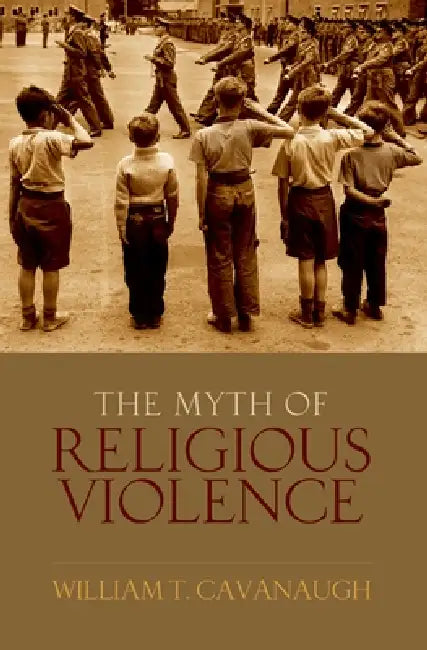
Myth of Religious Violence (English, William T. Cavanaugh)
4.7(44 reviews)Inclusive of all applicable taxes. Free shipping on orders above ₹499, else ₹49 flat.
Available Offers
- 🚚Free Delivery — Free on orders above ₹499, else ₹49 flat
- 💵Cash on Delivery — Pay when your order arrives
- ↩️15-Day Easy Returns — Hassle-free return policy
- 🔒Cash on Delivery — Pay safely when your order arrives
Check Delivery
Specifications
| Publisher | Oxford Univ PR |
| Language | English |
| ISBN-13 | 9780195385045 |
| ISBN-10 | 0195385047 |
| Author | William T. Cavanaugh |
Product Description
About the Book
The idea that religion has a dangerous tendency to promote violence is part of the conventional wisdom of Western societies, and it underlies many of our institutions and policies, from limits on the public role of religion to efforts to promote liberal democracy in the Middle East. William T. Cavanaugh challenges this conventional wisdom by examining how the twin categories of religion and the secular are constructed. A growing body of scholarly…
ISBN: 9780195385045
Book Insights
What You'll Learn
- ·In-depth exploration of topics covered in Myth of Religious Violence
- ·Key concepts explained with clarity and practical examples
- ·Insights valuable for anyone studying or working in Oxford Univ PR
Who Should Read This
Students and professionals interested in Oxford Univ PR, as well as general readers looking to expand their knowledge.
Key Highlights
- ·Brand new physical book delivered across India
- ·15-day hassle-free return policy
Customer Reviews
Excellent perspective on the 'myth's" surrounding religious violence or should ...
Excellent perspective on the 'myth's" surrounding religious violence or should I rephrase that to be wars claiming to be fought in the name of religion
Accessible, compelling, nuanced, topical - highly recommended
This is a hugely important book for any serious reflection on the putative link between religion and violence. It is especially relevant in our present day with the rise of ISIS and anti-Muslim sentiment in the West. It is also a welcome antidote to the New Atheist narrative which exploits the present climate to serve its own interests. Cavanaugh dispels one of today's big myths, that of "religion" being peculiarly prone to violence.Firstly, it is important to clarify what the book is NOT saying. It is not simply arguing that religion does not cause violence. To the contrary, Cavanaugh admits that certain religious ideologies, such as radical Islam, can and do promote violence under certain conditions. Rather, the argument is that there is no transhistorical or transcultural essence of religion which is necessarily more inclined to violence than are ideologies and institutions identified as secular. He argues that the distinction between "religious" and "secular" violence is itself a mythical construction to suit the modern liberal state and the Enlightenment narrative which proclaims the superiority of secular rationality and predominantly Western forms of life and thought. It is argued that this generalised picture of religion causing violence is "not an empirically demonstrable fact, but is itself an ideological accompaniment to the shifts in power and authority that mark the transition from the medieval to the modern in the West"Cavanaugh presents a compelling and nuanced argument. The book is a tour de force of social theory and intellectual history, and Cavanaugh convincingly challenges an impressive number of theorists in the field. The book is very accessible and detailed, and Cavanaugh has a helpful habit of continually reinforcing his central points throughout the book. Helpful areas for discussion include the intellectual history of the "secular" and "religion"; critical reflections on methodology (substantivist vs functionalist approaches); the influence of modernity and the national state, US foreign policy; and Muslim militancy.Perhaps a minor criticism from the general reader would be that the book is too detailed in places and could have been shorter. But I thought the added detail was necessary considering the unconventional argument Cavanaugh is advancing.Overall, I could not recommend this book enough and it will only become more relevant and useful in the coming years.
Read this book - it is outstanding
This is an absolutely mind-blowing book, and I would highly recommend it to literally everyone.The basic premise of the book is that religion is not a natural, obvious category of human life. It is an invented social construct from the modern West, and the religious-secular divide is directly implicated as a cause in the creation of the modern nation state. Religion emerges as a category to support the "secular" nation-state against sectarianism, and the "rational" West against the irrational and fanatical other.The author explores this in 4 chapters. Chapter 1 examines 9 scholars who separate religion and secular as "Absolutist", "Divisive" or "Irrational" (3 for each of these). The author systematically examines their arguments and demonstrates the incoherence of each. Chapter 2 examines the historic evolution of religion, from the Roman "religio" categorically linked to all public life and NOT about beliefs, to the modern idea of private, inner experience. This is further elaborated in the imposition of religion and the invention of Hinduism, Buddhism, Shinto, and Confucianism as world religions, the issues with both substantiast and functionalist views of religion, and the persistent denial of civil religion. Chapter 3 focuses on the myth of the wars of religion, demonstrating thoroughly that sectarian squabbling is an insufficient model to explain what actually happened in Reformation Europe. Chapter 4 explores the purpose of this myth - in particular, how it upholds civic religion and nationalism and contributes to American violence in the Middle East.This book is thoroughly researched. I deeply appreciate that every single paragraph of this book directly references a primary or secondary source, complete with dates, authors, quotes. This not only provides me with future reading material, but it demonstrates how deeply the author has engaged with this subject. I would highly recommend this book to every single person in the modern world.
Read this book!
This is a monumental book that all college philosophy majors and religious studies majors should read as soon as possible. The most provocative insight this book has to offer is that it makes it impossible to construct an argument or conversation about "religion" as some sort of autonomous and basic discourse that stands qualitatively separate from its "secular" counterpart. In other words, there is no way to define "religion" in a way that applies to all times and cultures while also maintaining that there is a category known as the "secular" which is distinct from the "religious." Thus, something like "American politics" cannot be categorically separated from something like "Islamic extremism" in terms of an appeal to whether or not each activity is "religious" or "secular." This has huge implications for the "New" atheists, all of which seem to target "religion" as if everyone knows what that means. Please read this book.
This book was recommended for providing a criti gue of the myth that ...
This book was recommended for providing a criti gue of the myth that the Enlightenmet and development of secularism replaced the conflicts which had caused primarily by religious intolerance. The author shows how violence perpetrated by Western democracies in their foreign policies goes largely unchallenged.