 -34% OFF
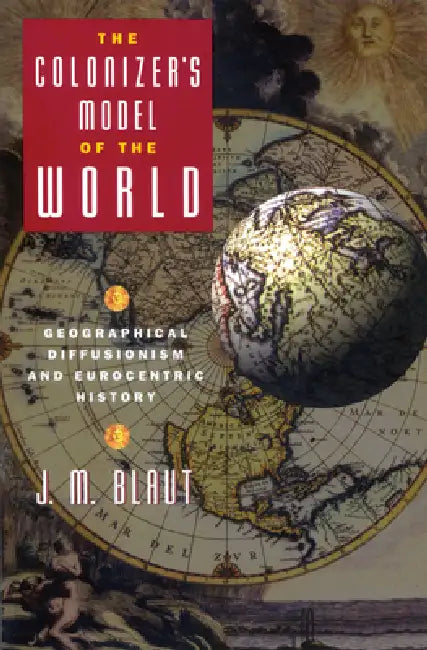
The Colonizer's Model of the World (English, J. M. Blaut)
4.3(43 reviews)Inclusive of all applicable taxes. Free shipping on orders above ₹499, else ₹49 flat.
Available Offers
- 🚚Free Delivery — Free on orders above ₹499, else ₹49 flat
- 💵Cash on Delivery — Pay when your order arrives
- ↩️15-Day Easy Returns — Hassle-free return policy
- 🔒Cash on Delivery — Pay safely when your order arrives
Check Delivery
Specifications
| Publisher | Guilford Publications |
| Language | English |
| ISBN-13 | 9780898623482 |
| ISBN-10 | 0898623480 |
| Author | J. M. Blaut |
Product Description
About the Book
This influential book challenges one of the most pervasive and powerful beliefs of our time--that Europe rose to modernity and world dominance due to unique qualities of race, environment, culture, mind, or spirit, and that progress for the rest of the world resulted from the diffusion of European civilization. J. M. Blaut persuasively argues that this doctrine is not grounded in the facts of history and geography, but in the ideology of colonial…
ISBN: 9780898623482
Book Insights
What You'll Learn
- ·In-depth exploration of topics covered in The Colonizer's Model of the World
- ·Key concepts explained with clarity and practical examples
- ·Insights valuable for anyone studying or working in Guilford Publications
Who Should Read This
Students and professionals interested in Guilford Publications, as well as general readers looking to expand their knowledge.
Key Highlights
- ·Brand new physical book delivered across India
- ·15-day hassle-free return policy
Customer Reviews
Historic
Great historic analysis of the evolution of mercantilism and global capitalism.
A classic.
Written by a young professor whose life ended tragically early, he eagerly takes on most of the contemporary world views of history, challenging their Eurocentrism and biases.
Refuting Eurocentrism
James Blaut, a geographer at the University of Illinois at Chicago, is particularly known for his excellent refutations and polemics against Eurocentrism in economic history. This book, "The Colonizer's Model of the World", is the pinnacle of that oeuvre, together with its companion work Eight Eurocentric Historians.The first and largest part of the book is devoted to refuting the mythology and mistakes of Eurocentric diffusionism, a body of theories and statements which purport to show that Europe or Europeans were in some way, whether mentally or physically or economically or environmentally or culturally, superior to Asians, Africans and other non-Europeans before the 'discovery' of America. Blaut does this by analyzing systematically the works of many recent and past popularizers of these theories, from the 'hydraulic societies' of Karl Wittfogel to the contemporary racist historiography of Eric L. Jones, and subjecting them to an unsparing criticism for their erroneous assumptions and ignorance of the non-European world. As Blaut shows, China, India, Southeast Asia and even Africa were not lagging behind Europe in any respect before 1492, including but not limited to technology, individual freedom (or lack thereof), and demographics. He also makes many essential geographic points, such as refuting the theories that tropical conditions are inherently unsuited for working or thinking, or that tropical soil is necessarily less fertile, or that Europe relied on rainfall agriculture unlike Asia. The book "Eight Eurocentric Historians" builds upon this part and goes into more detail about it.The second part of the book is a discussion of the state of feudalism in Europe and elsewhere (about the same level of development except for the Americas, as Blaut shows) before 1492, and the immensely rapid growth, change, and development Western and Southern Europe underwent in the period roughly from 1492 to 1700. Blaut persuasively argues that only the colonization of the Americas, with the enormous influx of wealth and capitalistic production relations resulting from gold and silver mining and plantation work (particularly sugar), can adequately explain this phenomenon. He also explains why it was Europe that conquered America rather than the opposite, the answer being disease, and why it was Europe as opposed to Asia or Africa that did this, the answer being geographical location and advantageous wind patterns for sailing.Blaut is unsparing and polemic in his writing, occasionally getting preachy, but his case is strong and aims home. He even criticizes otherwise radical authors for their failing in this regard, often legitimately, such as Marx and to a lesser extent Engels, Robert Brenner, Perry Anderson, and others. I do not endorse or support all his critiques on this field, as Blaut occasionally goes overboard, and his endorsement of Martin Bernal's "Black Athena" theory, now discredited, does not aid his case. (It must be noted that this book was written in 1993, and the refutation of this theory in "Black Athena Revisited" (Black Athena Revisited) was published in 1996.) Blaut nonetheless gives good cause also for the radical historians to revise and change the substance of some of the classic Marxist historical view - his book is yet more confirmation that the concept of the "Asiatic mode of production" is untenable and must be discarded, and it also gives more argument for introducting "protocapitalism" as a separate mode of production in between feudalism and Industrial Revolution capitalism, although Blaut himself is not yet willing to do so.What is most important about this book however is not its historiographical import, but the essential corrective it is to much of the still popular view of world history and the development of Europe and its superior position. From Tarzan to Tintin and from Kipling to the popular view of American Indians, the entire picture of the interactions between Europe and the rest of the world are for many people still unwittingly based on completely incorrect Victorian prejudices and assumptions. This goes not just for the average guy, but even for intellectuals, in fact even for professional historians. And if Blaut's book could make a dent in this vision, it will have made a major contribution to international understanding and historical sense.
Very educational
Loved it. Very educational & very interesting.