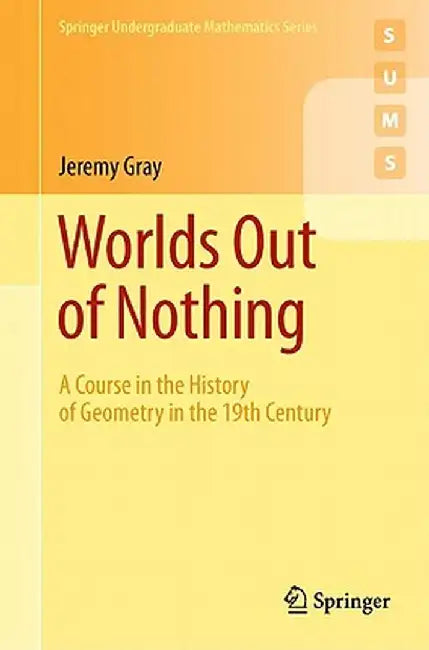
Worlds Out of Nothing (English, Jeremy Gray)
4.3(3 reviews)Inclusive of all applicable taxes. Free shipping on orders above ₹499, else ₹49 flat.
Available Offers
- 🚚Free Delivery — Free on orders above ₹499, else ₹49 flat
- 💵Cash on Delivery — Pay when your order arrives
- ↩️15-Day Easy Returns — Hassle-free return policy
- 🔒Cash on Delivery — Pay safely when your order arrives
Check Delivery
Specifications
| Publisher | Springer |
| Language | English |
| ISBN-13 | 9780857290595 |
| ISBN-10 | 0857290592 |
| Author | Jeremy Gray |
Product Description
About the Book
From the Back Cover Worlds Out of Nothing is the first book to provide a course on the history of geometry in the 19 th century. Based on the latest historical research, the book is aimed primarily at undergraduate and graduate students in mathematics but will also appeal to the reader with a general interest in the history of mathematics. Emphasis is placed on understanding the historical significance of the new mathematics: Why was it done? How…
ISBN: 9780857290595
Book Insights
What You'll Learn
- ·In-depth exploration of topics covered in Worlds Out of Nothing
- ·Key concepts explained with clarity and practical examples
- ·Insights valuable for anyone studying or working in Springer
Who Should Read This
Advanced students, researchers, and domain experts seeking in-depth knowledge.
Key Highlights
- ·Brand new physical book delivered across India
- ·15-day hassle-free return policy
Customer Reviews
The history of geometry
This is exactly what it promises : a history of geometry. There was a lot of stuff I didn't know about to make this book worthwhile. There is a somewhat weirder chapter in which the author warns about interpretations that become facts. Because not everybody has the time to read through all the sources, the opinion of the one that "summarizes" it tends to be interpreted as facts after him/her. That chapter alone is already enough to justify the purchase.
...
Does exactly what it says on the tin
Interesting but somewhat irritating as well (3.5 stars)
As a "general reader," rather than a student using this book in a university course, I found the material highly interesting but the treatment often frustrating.On the plus side, I did come away from it with a better understanding of the substance and goals of projective geometry, of the intellectual context of non-Euclidean geometry, and of what might be called the struggle for co-existence (pace Darwin) of multiple geometries at the end of the 19th Century.Several aspects of the book were ver