 -23% OFF
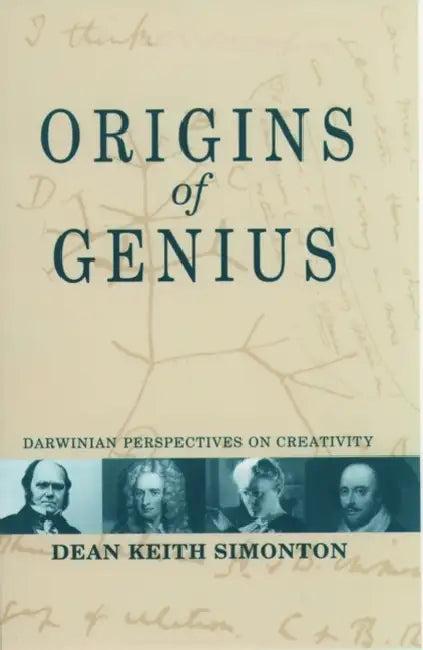
Origins of Genius (English, Dean Keith Simonton)
4.6(17 reviews)Inclusive of all applicable taxes. Free shipping on orders above ₹499, else ₹49 flat.
Available Offers
- 🚚Free Delivery — Free on orders above ₹499, else ₹49 flat
- 💵Cash on Delivery — Pay when your order arrives
- ↩️15-Day Easy Returns — Hassle-free return policy
- 🔒Cash on Delivery — Pay safely when your order arrives
Check Delivery
Specifications
| Publisher | Oxford University Press |
| Language | English |
| ISBN-13 | 9780195128796 |
| ISBN-10 | 0195128796 |
| Author | Dean Keith Simonton |
Product Description
Here on GlowMirror, you'll find Origins of Genius filed under Oxford University Press -- everything you need to know is covered below.
About the Book
In Origins of Genius, Dean Simonton reveals how Darwin's theory of natural selection can be used to explain the psychology of creative geniuses. Simonton not only uses Darwin's ideas to explain the creative genius of many eminent scientists and artists, b
ISBN: 9780195128796
Book Insights
What You'll Learn
- ·In-depth exploration of topics covered in Origins of Genius
- ·Key concepts explained with clarity and practical examples
- ·Insights valuable for anyone studying or working in Oxford University Press
Who Should Read This
Students and professionals interested in Oxford University Press, as well as general readers looking to expand their knowledge.
Key Highlights
- ·Brand new physical book delivered across India
- ·15-day hassle-free return policy
Customer Reviews
A Book Ripe With Ideas
Origins of Genius by Dean Keith Simonton is idea dense study of the origin and nature of creativity from a Darwinian perspective, not a study of genius in the popular sense of the word. Simonton convincingly explains his choice of using eminence as a measure of genius rather than test measurements of raw intelligence.Using Charles Darwin as an example of creativity and eminence throughout the book, Simonton looks at the cognitive processes that give rise to new ideas with a mixture of individual reports of eminent individuals, scientific studies and modern computer models of creativity, making sure to set a distinction between primary and secondary Darwinian models.I found the section discussing the creative output of individuals of eminence and the section discussioning blind selection and selection retention in cognitive functioning the most interesting sections the book. The fact that total output and being cited are two of the best indicators of eminence sheds doubt on the common perception that quality is the most important aspect of creative works.The discussion of the developmental change of creative products is also worth noting, especially the sections discussion Martindale’s empirical analysis of the development of artistic styles using primordial cognition and aesthetic selection to follow the course of the product until primordial cognition begins to disintegrate, creating a cyclical pattern of artistic production.It’s hard to do justice to the amount of information touched upon in this book in a short review. It is a book ripe with ideas that will change the way the reader views the creative process and it will change the way the reader understands the eminent figures throughout world history.If you’re interested in eminent individuals, the process of creativity, Darwinian models of cognition or just better wish to understand the workings of the human mind, I cannot recommend this book highly enough. I will be reading it again.
NA
NA
Biological exegesis of creativity
As the title indicates, an evolutionary explanation for the rise of genius. This book requires, if not an already-present aptitude for biology, a willingness to follow the author's train of thought. It is obvious that this book is written for a fairly specialized audience, because no real effort is made to make the undoubtedly fascinating material palatable. The author, instead, like a good scientist, overloads the prose with this study and that study and gets bogged down in various plausible biological explanations which make getting through this tome a bit of a struggle.Nevertheless, as I said, the subject matter is fascinating, and while the book is slightly difficult to read, it is not impossible. The author clearly differentiates between primary darwinism, which is natural selection on the organic level, and secondary darwinism, which is natural selection on the sociocultural level. The author argues that genius is uniquely equipped to increase its adaptive fitness in the sociocultural sphere (here, the author is drawing on Dawkins' notion of the meme), by being more ready than most to engage in a trial-and-error blind variation selection process. This is the crux of the text, as the author investigates various facets of genius that allow this unusually vigorous adaptive struggle in the sociocultural sphere, including with a discussion on the thinking processes that are unique to genius and which help them come up with fresh 'ideational variations', the role of culture and personality in either hindering or furthering genius. The author is a fairly strict determinist in this latter aspect, believing genius to be mostly genetic. One remaining minor quibble that I have is that the author isn't quite sure where he comes down on the genius issue. He seems initially to favor the view that genius is an adaptive phenomenon forced into existence by the selection pressures of the sociocultural milieu. Later, when discussing emergenesis (offspring inheriting genes that are not those of their parents, but rather, perhaps of their great-grandparents, i.e. of genes emerging suddenly after a period of 'hibernation'), he seems to lean towards an explanation of genius as that of a 'freak of nature'. This inability to come down strictly on one side is perhaps to be expected from a scientist, but it does mean that the book doesn't really read like a book, but more like a dissertation.In conclusion, I would say that this is a worthwhile text for life sciences students, and those interested in evolutionary biology and who have read a few of the classic tomes of that genre and are thus well versed with slightly in depth evolutionary explanations
Excellent
One of the best books I've read in years.Simonton does a great job of linking old and new ideas into something meaningful. He references many known and reliable studies to prove out his points. He also assumes that the reader has a good background knowledge on related issues, so he doesn't belabor things that we already know.Due to the complexity of the topic, it is very detailed. I wouldn't really describe it as a recreational read, but it is well work the effort. You'll be surprised and challenged by the things you'll learn.