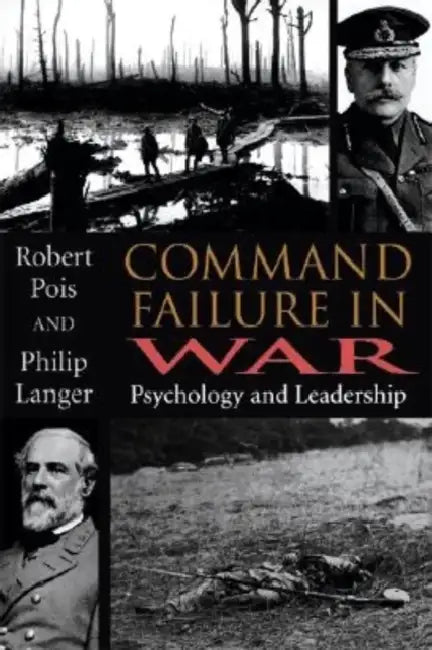
Command Failure in War (English, Robert A. Pois | Philip Langer)
4.5(12 reviews)Inclusive of all applicable taxes. Free shipping on orders above ₹499, else ₹49 flat.
Available Offers
- 🚚Free Delivery — Free on orders above ₹499, else ₹49 flat
- 💵Cash on Delivery — Pay when your order arrives
- ↩️15-Day Easy Returns — Hassle-free return policy
- 🔒Cash on Delivery — Pay safely when your order arrives
Check Delivery
Specifications
| Publisher | Indiana University Press (Ips) |
| Language | English |
| ISBN-13 | 9780253343789 |
| ISBN-10 | 025334378X |
| Author | Robert A. Pois | Philip Langer |
Product Description
About the Book
Why do military commanders, most of them usually quite capable, fail at crucial moments of their careers? Robert Pois and Philip Langer--one a historian, the other an educational psychologist--study seven cases of military command failures, from Frederick the Great at Kunersdorf to Hitler's invasion of Russia. While the authors recognize the value of psychological theorizing, they do not believe that one method can cover all the individuals, batt…
ISBN: 9780253343789
Book Insights
What You'll Learn
- ·In-depth exploration of topics covered in Command Failure in War
- ·Key concepts explained with clarity and practical examples
- ·Insights valuable for anyone studying or working in Indiana University Press (Ips)
Who Should Read This
Students and professionals interested in Indiana University Press (Ips), as well as general readers looking to expand their knowledge.
Key Highlights
- ·Brand new physical book delivered across India
- ·15-day hassle-free return policy
Customer Reviews
Five Stars
Received the book in good condition
Fascinating perspective
I found the psychological insights to historical military events to be interesting. In a previous incarnation I taught management "science" and the psychological failures/flaws of people like General Lee, Napoleon, Hitler, Churchill, etc. are found in lesser beings in board rooms around the world. The insights in this book would be useful to a student of business and political as well as military leadership. The authors, one a historian and the other a psychologist, and both academics, elected to write about military conflicts of global proportions in order to make their point. This is understandable. The academic tendencies tend to sound a little like a college text book at times (which this may be the case) and this gets a little ponderous at times. But, it is worth sticking with it because the central theme is a common flaw in business, education, government, and every other endeavor where you have people leading other people. If you hold any kind of leadership position you should read this book. I wish I had this book when I was teaching this stuff. It would have made things a little more interesting.