 -60% OFF
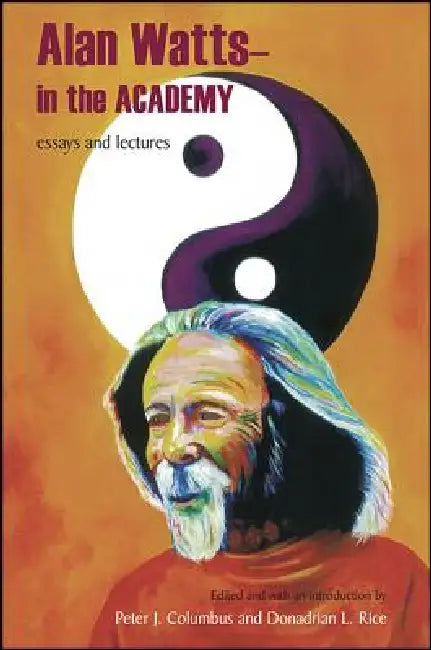
Alan Watts - In the Academy (English, Alan Watts | Peter J. Columbus | Donadrian L. Rice)
4.5(11 reviews)by Alan Watts | Peter J. Columbus | Donadrian L. Rice
Publisher: State University of New York Press
Language: English
Inclusive of all applicable taxes. Free shipping on orders above ₹499, else ₹49 flat.
Available Offers
- 🚚Free Delivery — Free on orders above ₹499, else ₹49 flat
- 💵Cash on Delivery — Pay when your order arrives
- ↩️15-Day Easy Returns — Hassle-free return policy
- 🔒Cash on Delivery — Pay safely when your order arrives
Check Delivery
Specifications
| Publisher | State University of New York Press |
| Language | English |
| ISBN-13 | 9781438465555 |
| ISBN-10 | 1438465556 |
| Author | Alan Watts | Peter J. Columbus | Donadrian L. Rice |
Product Description
About the Book
Gold Winner for Philosophy, 2017 Foreword INDIES Book of the Year Awards To commemorate the 2015 centenary of the birth of Alan Watts (1915-1973), Peter J. Columbus and Donadrian L. Rice have assembled a much-needed collection of Watts's scholarly essays and lectures. Compiled from professional journals, monographs, scholarly books, conferences, and symposia proceedings, the volume sheds valuable light on the developmental arc of Watts's thinking…
ISBN: 9781438465555
Book Insights
What You'll Learn
- ·In-depth exploration of topics covered in Alan Watts - In the Academy
- ·Key concepts explained with clarity and practical examples
- ·Insights valuable for anyone studying or working in State University of New York Press
Who Should Read This
Working professionals and industry practitioners seeking practical knowledge.
Key Highlights
- ·Brand new physical book delivered across India
- ·15-day hassle-free return policy
Customer Reviews
"you didn't come into this world. you came out of it like a wave from the ocean." -Alan Watts
When I read the footnotes with as much joy as the main text, I know I’m really enjoying a book. I really loved this book. It gave me a chance to reevaluate Alan Watts and his influence on my own view of the world [which is greater than I thought a year ago]. So much of the ideas in his writings have seeped into my worldview [not everything] without me being aware that I came across the ideas in his books first.I think his interests are often more far ranging then both his critic’s and fan’s interests, thus his critics nitpick over their particular limited field of specialty uninterested in what Watts was doing in fitting that narrow part into a much larger vision. His fans pick out a few things they like and then reduce his though to a few ideas or catch phrases. Either way the breath of Watts’ inquiring thought is overlooked. But not here in this great collection of his more academic writings on a variety of topics."The perspicacity of Watts' thinking is jaw roping. He was the first person to write seriously about Zen...the first to conduct a seminar at Esalen, and one of the first to propose linking Eastern philosophy and Western psychology...[He anticipated] the now prominent distinction between spiritual quest and religious affiliation. Ingesting psychedelics two years before Timothy Leary did, Watts became a principle spokesman for their spiritual value and even proposed that their use be protected constitutionally. Watts wrote about the psychology of acceptance one of the central issues in 21st-century cognitive behavioral psychotherapy as early as 1939. His Nature, Man, and Woman 1958) was one of the earliest feminist critiques of Western religion, preceding most others by decades, as well as a forerunner to the modern environmental movement." Heide (quoted in the introduction from her 2013 article, A lap unto himself)The books is a collection of his harder to find more academically inclined articles over the full course of his writing life. As someone who enjoys his more academic works [Way of Zen, Nature Man and Woman, Supreme Identity] this was a treasure trove of mostly new writings for me. I’ll list how the work was divvied by topics to give everyone a sense of the range of content:part1 Language and mysticismpart2: Buddhism and Zenpart3: Christianitypart4: Comparative religionpart5: Psychedelicspart6 Psychology and PsychotherapyWatts was never satisfied with addressing a limited academic audience, he really felt some ideas, and views about the world were too important to keep sequestered for a few and he also felt they were more relevant and relatable then most other people thought. In some ways he was a big part of bringing mystical thought into open public discourse for good and bad I suppose.[mostly good in my opinion].Or as Alan Watts says, "As in some economies the rich keep getting richer and the poor poorer, so in the overspecialized disciplines of modern scholarship the learned get more learned and the ignorant get more ignorant-until the two classes can hardly talk to each other. I have dedicated my work to an attempt to bridge this gap" [quoted in the introduction]I think Reed Baird from his 1988 article: The influence of Oriental mysticism on American thought, quoted in the introduction gives a beautiful vision of Watt's core gift, his offering to the world:"At a time in a burning and anguished world when theologians spoke either of a 'wholly other' or totally dead God, when philosophers lost themselves in intricate analyses of the meaning of meaning, and when far too many psychologists occupied themselves with experiments on rats and denied man's [people's] freedom, dignity, even his [their] very consciousness, Alan Watts sought to restore man's[people's] sense of being at home in the world...Watts' greatest gift was his ability to contribute to the revitalization of America’s intellectual and spiritual life, precisely through his remaining always a 'divine amateur' who was therefore freer than most intellectuals to perceive and express healing versions of Reality not generally available to modern consciousness.”In the end I find his core intellectual intuition was we are at home in this world if we but can see it so, that vision changes everything, our relations to our bodies, the environment, to each other and to ourselves. It was a mystical vision but also a cultural, progressive, experimental and playful vision. He wasn’t satisfied with past mystical expressions as much as he loved and was inspired by them, he was a harbinger of more inclusive and more culturally challenging visionings of Sacredness.