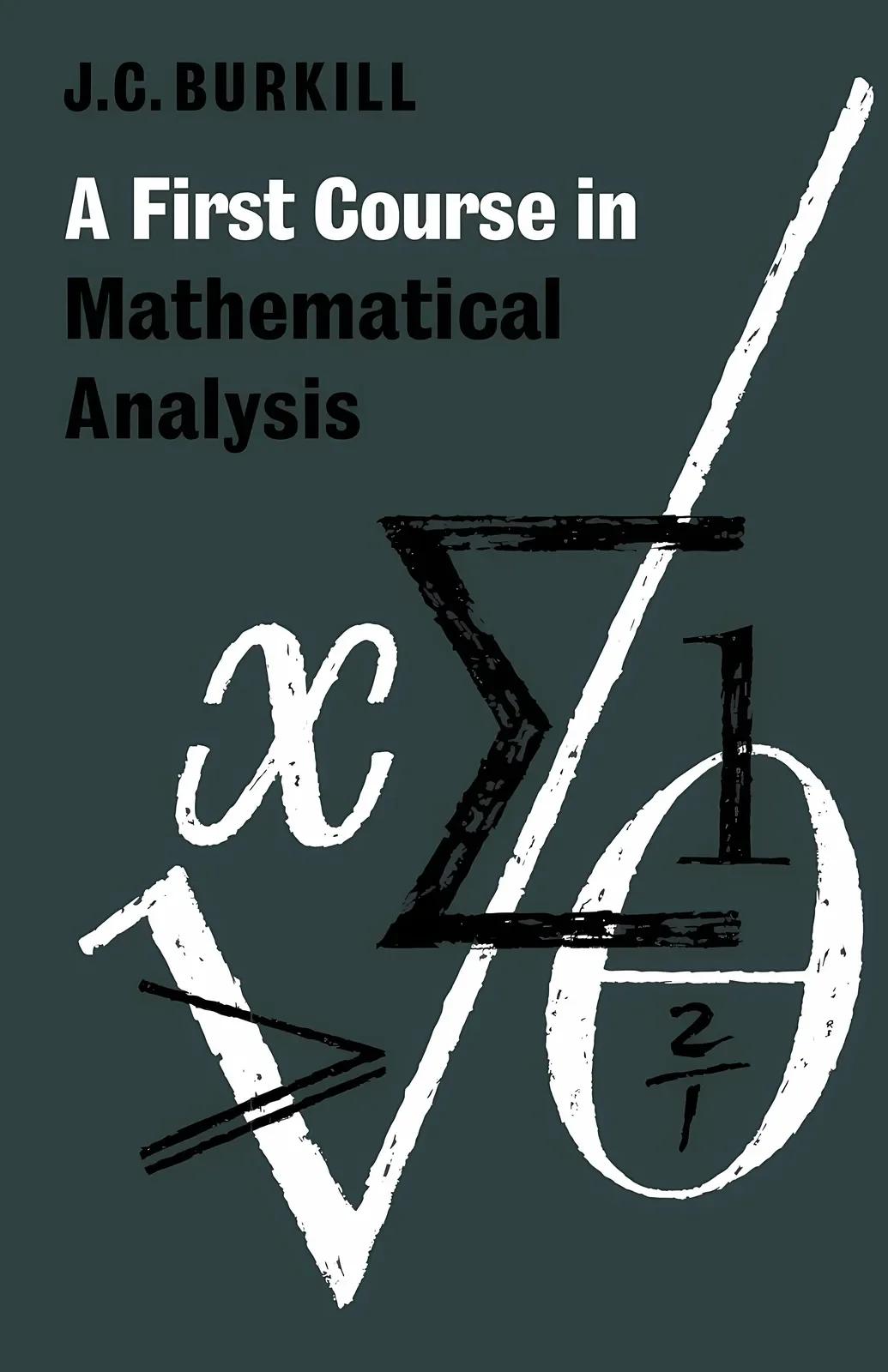
A First Course in Mathematical Analysis (English, John C. Burkhill)
4.6(13 reviews)Inclusive of all applicable taxes. Free shipping on orders above ₹499, else ₹49 flat.
Available Offers
- 🚚Free Delivery — Free on orders above ₹499, else ₹49 flat
- 💵Cash on Delivery — Pay when your order arrives
- ↩️15-Day Easy Returns — Hassle-free return policy
- 🔒Cash on Delivery — Pay safely when your order arrives
Check Delivery
Specifications
| Publisher | Cambridge University Press |
| Language | English |
| ISBN-13 | 9780521294683 |
| ISBN-10 | 0521294681 |
| Author | John C. Burkhill |
Product Description
Here on GlowMirror, you'll find A First Course in Mathematical Analysis filed under Reference -- everything you need to know is covered below.
About the Book
This straightforward course based on the idea of a limit is intended for students who have acquired a working knowledge of the calculus and are ready for a more systematic treatment which also brings in other limiting processes, such as the summation of infinite series and the expansion of trigonometric functions as power series. Particular attention is given to clarity of exposition and the logical development of the subject matter. A large numb…
ISBN: 9780521294683
Book Insights
What You'll Learn
- ·In-depth exploration of topics covered in A First Course in Mathematical Analysis
- ·Key concepts explained with clarity and practical examples
- ·Insights valuable for anyone studying or working in Reference
Who Should Read This
Students at the undergraduate and postgraduate level, as well as educators.
Key Highlights
- ·Brand new physical book delivered across India
- ·15-day hassle-free return policy
Customer Reviews
There is no better recommendation!
Professor Brian Kuttner's text book for first year mathematicians in 1972. There is no better recommendation!
Best Introduction I have ever seen
Absolutely stellar.I feel a little amused by the author using the word "hitherto" way too much but overall the book is very readable and the proof is clearly written, and the logical follow is easy to follow.It serves two purposes excellently aside from your assigned textbook:(A) If you just finished univariate calculus, you can immediately upgrade your knowledge by reading this book. You can also read that together with Calculus I. So you don't need to jump from Calculus II to Rudin/Apostol, and end up with "I can do the proof but I don't know where they come from or why we need them" at most.(B) If you are not a pure mathematician but need some knowledge in analysis. Mostly likely you don't need compactness other than a closed interval or fields other than R or C in your own work.In short, this textbook covers the minimal information of (univariate, except for the last chapter)analysis and nothing more. The author does not even mention limsup, Cauchy convergence criteria and open sets,which is covered by the author's other book "A second course in mathematical analysis, and keep number of theorems to a minimum.So, you do need to discover things yourself (For instance, you probably discover sandwich theorem, or maybe the notion of subsequence and its properties when you are doing some problems in chapter 2 ) This is actually a good thing: Many people want to see the skeletons first and add details later and do not want to be overwhelmed by 20+ theorems in a single chapter. Also notice that some conclusions are not in the form of theorems but just appears as plain texts along the way. Since the books is <200 pages, it's less of a problem though.Most exercises are easy. Paradoxically some of the trickiest is in Chapter 1.
Great book
Well presented and explains well.
An ideal first analysis book
This book is entirely appropriate as an introduction to analysis for students already familiar with the Calculus. It is on the reading list at Cambridge and Oxford for their undergraduate analysis courses and its reputation is well established. It is not too abstruse but is exceptionally clear and straightforward.
Good if you don't really need it
A neat introduction to Analysis. Its size however does create its own problems. Explanations are brief and key ideas are sometimes skipped. Like many small UK maths books, it's great if you already know the material or are very clever. Otherwise students would be better off with a more expansive US textbook.